Record Acoustic Guitar at Home With More Clarity
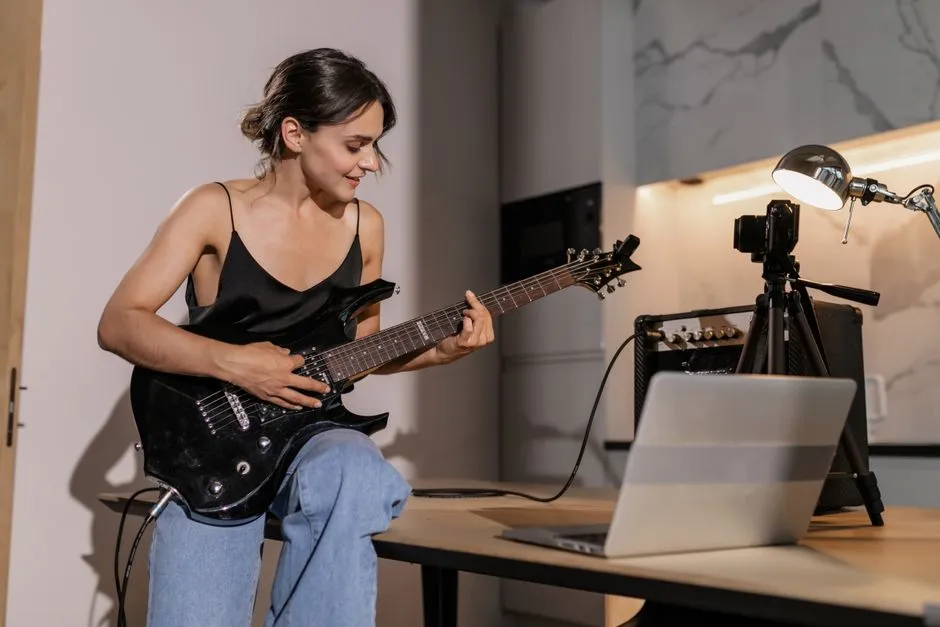
Record the instrument, player, and room together
Acoustic guitar recording begins with the part and the space, not a favorite microphone diagram. Tune, eliminate chair squeaks and jewelry noise, then listen while the player performs in several room positions. Choose the location where the guitar sounds balanced before the microphone turns that decision into evidence.
Use the room-treatment guide to control obvious reflections. Install only stable materials with documented mounting and fire information, and keep textiles away from heat, electrical equipment, lights, detectors, and exits.
Avoid aiming automatically at the sound hole
The sound hole can produce more low-frequency energy than the finished track needs. A practical starting point is near the area where the neck meets the body, aimed and distanced according to the desired balance. Record a short passage, then move toward the body for more weight or toward the neck for more string detail.
Those tendencies are starting clues, not laws. Guitar construction, playing style, room, and microphone all change the result. Compare takes at the same playback level.
Let distance balance detail and room
A close position emphasizes direct sound and reduces the room's share, but small player movements can change tone dramatically. A farther position may capture a more integrated instrument while inviting more reflections, traffic, and foot tapping into the arrangement.
Choose a distance the player can repeat without an awkward posture. Secure the stand against tipping and keep its legs outside the player's foot path. Route cables away from feet and doors, and secure them without creating raised tape edges. Leave clear space for the performer's full playing movement.
Set levels from the hardest passage
Have the guitarist play the strongest strum, loudest bass note, and any percussive techniques before the take. Establish clean recording gain staging with margin for enthusiasm. Monitor for pick clicks, fret buzz, clothing noise, and stand vibration.
Headphone exposure depends on both sound level and time, and noise-induced hearing loss is permanent. NIOSH describes 85 dB(A) over eight hours as an occupational limit, with allowable time halved for every 3 dB increase, while cautioning that this is not a recreational-listening guarantee. Reduce level and exposure time rather than asking the player to compete with the cue mix; see NIOSH guidance.
Decide whether one microphone is enough
One well-placed microphone is easier to manage and often gives a focused result. Two microphones can provide width or tonal options, but their timing relationship may create cancellations when combined. Move either microphone and recheck the blend in stereo and mono.
Add a second microphone only when it solves a musical problem. “The interface had another input” is a fact, not an arrangement decision.
Fit the guitar around the song
A solo acoustic tone may sound full and luxurious, while the same tone crowds a vocal and bass. Record a test with the complete arrangement and adjust performance, voicing, microphone position, or part density before relying on heavy processing.
If two guitar takes are used for width, record two real performances. Keep rhythm and chord length intentional so the pair supports rather than smears the groove.
Edit with the instrument's decay intact
Choose complete phrases where possible. Crossfade edits at stable points and listen through chord tails, breaths, squeaks, and transitions. Remove distracting noise carefully, but do not erase all evidence that a person touched wood and strings.
Use the broader vocal microphone placement method—controlled comparisons, repeatable positions, and context—to guide every move. Save notes about guitar, tuning, capo, pick, room position, and microphone placement.
A strong home recording is not the one with the fanciest stereo technique. It is the one where the rhythm feels settled, the tone supports the arrangement, and the listener forgets to wonder where the microphone was.
Music-production guidance here is general education. Protect your hearing, use electrical equipment as directed, keep backups, and obtain appropriate rights or permission for material you record, sample, distribute, or release.